Heavy Duty Transfer Cars
Overview
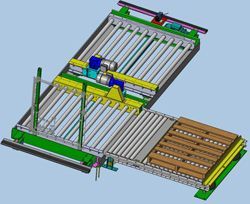
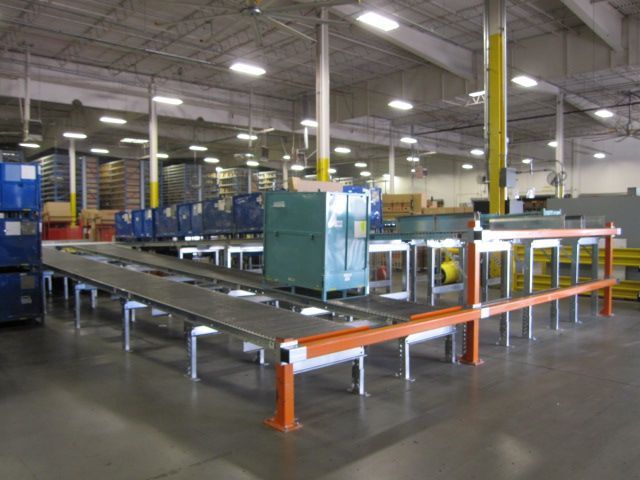
Industrial Kinetics Heavy Duty Transfer Cars are engineered systems used for the transport, positioning, and sortation of heavy units within processing, assembly, and finishing operations. These transfer cars provide controlled lateral or longitudinal movement of products between parallel conveyor lines, workstations, ovens, test chambers, or process cells where traditional fixed conveyors are not practical.
Designed for extreme loads, harsh environments, and precise positioning requirements, Heavy Duty Transfer Cars are built as structural machines rather than light-duty shuttles. Each unit is engineered to the application, balancing load capacity, travel accuracy, environmental conditions, and system throughput.

Specifications
| Feature | Specification |
|---|---|
| Equipment Type | Heavy Duty Transfer Car / Shuttle Car |
| Primary Function | Transport and sortation of heavy unit loads between fixed process points |
| Car Construction | Welded structural steel frame; Formed steel components where appropriate |
| Travel Direction | Straight-line transfer; Bidirectional shuttle operation |
| Guidance System | Wheel blocks operating on ASCE rail; Flat or flanged wheel arrangements depending on alignment requirements |
| Drive Arrangements | Chain-driven in-floor or onboard drive; Electric motor-driven with gearbox and braking; Pneumatic or air-motor drives for special environments |
| Typical Travel Speeds | Application dependent, optimized for load stability and positioning accuracy |
Controls
- PLC-based control system coordinating travel, positioning, and load transfer
- Variable frequency drives for smooth acceleration, deceleration, and speed regulation
- Independent wheel drive synchronization where required
- HMI interface for system status, fault diagnostics, and manual control
- Proximity sensors and flags for slowdown and in-position confirmation
- Laser or distance-measuring devices for high-accuracy car positioning
- Safety-rated E-stop circuits, rope pulls, and area scanners as required
- Audible and visual warning devices prior to car movement
Load Capacities
- Designed for very heavy unit loads commonly ranging from several thousand pounds to well over 100,000 pounds
- Load capacity dependent on:
- Frame construction and wheel arrangement
- Rail size and support structure
- Drive system and braking requirements
- Systems are engineered to safely handle both dynamic (in-motion) and static (stationary) load conditions
Options
- Integrated conveyor decks (CDLR, chain conveyor, or belt conveyor)
- Cart or carrier-style transfer cars for direct load support
- Energy chain electrification with super-flex cable
- Conductor bar electrification systems
- Battery-powered transfer cars with onboard charging
- End-of-travel shock absorbers and buffers
- High-temperature components for oven or furnace-adjacent service
Non-Standard Features
- Redundant braking systems for critical safety applications
- Wireless communication between stationary and car-mounted controls
- Custom rail, pit, or runway integration coordinated with facility structure
- Specialized guarding, fencing, or aisle-crossing safety systems
Why Choose Us
Industrial Kinetics Heavy Duty Transfer Cars are engineered as mission-critical machines for demanding industrial environments. With extensive experience in heavy assembly, testing, and processing systems, Industrial Kinetics designs transfer cars that prioritize structural integrity, controlled motion, and long-term reliability.
By combining in-house mechanical design, controls engineering, and manufacturing, Industrial Kinetics delivers transfer car systems that integrate seamlessly into complex production processes and operate reliably under extreme load and environmental conditions.
success stories
System Integration
Heavy Duty Transfer Cars are commonly integrated with chain driven live roller conveyors, drag chain conveyors, turntables, lifts, and process equipment such as ovens or test chambers. Control systems coordinate car movement with conveyor operation, safety devices, and process interlocks to ensure precise load transfer and safe operation. These transfer cars often serve as key routing and buffering elements within automated heavy material handling systems.
What industries typically use these systems:
01
Heavy manufacturing and assembly lines
02
Heat treat, annealing, and finishing systems
03
Test chambers and acoustic or pressure testing facilities
04
Steel, transformer, and power equipment processing
05
Industrial equipment and large fabricated product handling
Frequently Asked Questions
What differentiates a heavy duty transfer car from a standard transfer car?
Heavy duty transfer cars are designed for significantly higher loads, harsher environments,, using structural frames, and higher capacity wheels.
Can transfer cars operate in high-temperature environments?
Yes. Transfer cars can be engineered with high-temperature bearings, lubricants, and components for oven- or furnace-adjacent applications.
How is positioning accuracy achieved?
Positioning is achieved through a combination of controlled drives, proximity sensors, and optional laser or distance-measuring devices.
Can transfer cars include onboard conveyors?
Yes. Transfer cars can be equipped with integrated conveyor decks to allow powered transfer of loads on and off the car.
Are heavy duty transfer cars custom engineered?
Yes. Each Heavy Duty Transfer Car is engineered specifically to the application, including load, environment, controls, and facility integration requirements.
Request a Quote. Start Your Project Today
2535 Curtiss St.
Downers Grove, IL 60515
Phone: (630) 655-0300
Fax: (630) 655-1720
Heavy Duty Transfer Cars (Heavy Industry&Automotive) Contact Form
We will get back to you as soon as possible.
Oops, there was an error sending your request. Please try again later.