Heavy Duty Belt on Roller Conveyor
Overview
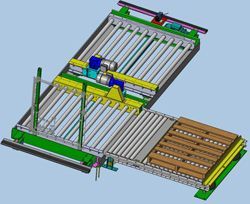
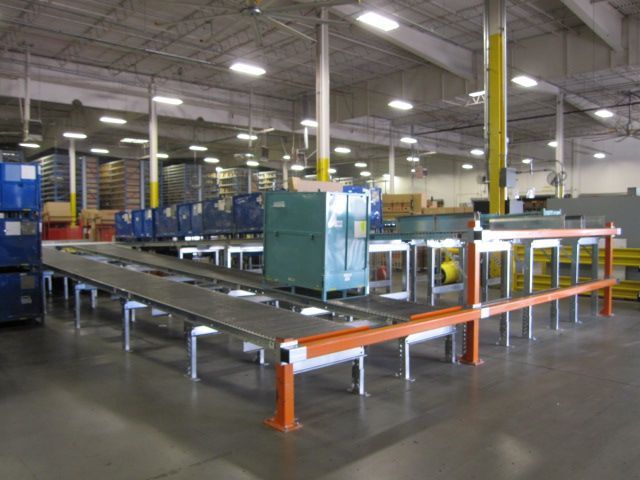
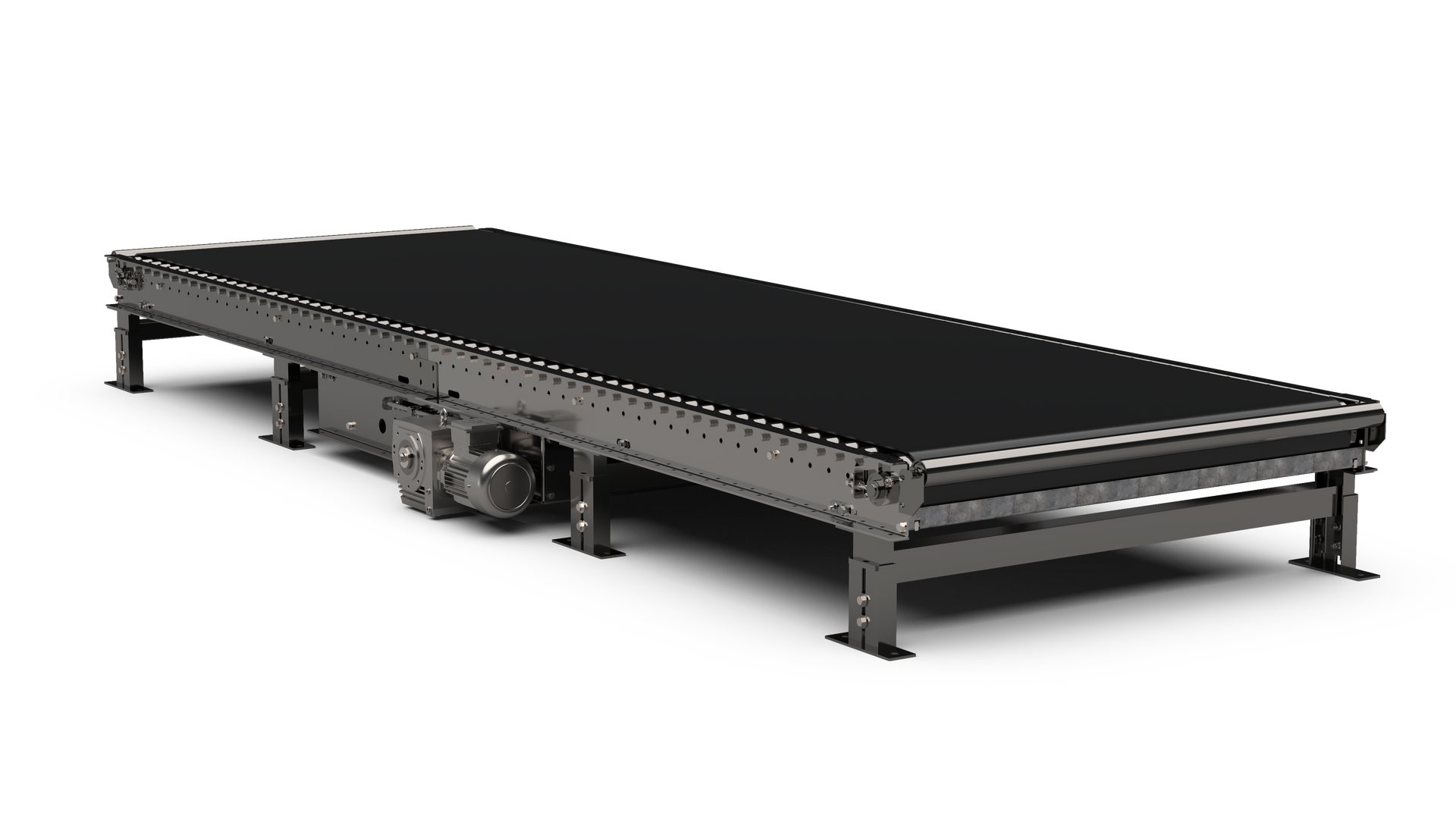
Heavy Duty Belt on Roller Conveyors are designed for the reliable transportation of unitized loads, loads with inconsistent bottom surfaces, and supersacks. By combining a continuous belt supported by closely spaced rollers, this conveyor provides stable load support while maintaining the strength and durability required for demanding industrial applications.
This conveyor style is commonly applied where traditional roller conveyors are not suitable due to uneven load bottoms or where belt conveyors alone require additional structural support. The belt-on-roller design aligns with CEMA unit-handling principles for heavy-duty conveying.

Specifications
| Feature | Specification |
|---|---|
| Conveyor type | Heavy duty belt on roller conveyor |
| Belt support | Continuous belt supported by rollers |
| Roller diameter | 2-1/2 in |
| Roller material | Pre-galvanized steel |
| Roller centers | 3 in or 6 in (application dependent) |
| Frame construction | Formed steel frame |
| Frame depth | 8 in |
| Frame thickness | 4 gauge |
| Drive configurations | 4 in diameter end drive 6 in diameter end drive 8 in diameter end drive 8 in diameter center drive |
| Terminal end | 4 in diameter adjustable terminal |
| Units | Imperial |
Available Configurations
The following representative configurations are available based on drive size, drive location, and roller spacing: - 4 in diameter end drive with 2-1/2 in rollers on 3 in centers - 4 in diameter end drive with 2-1/2 in rollers on 6 in centers - 6 in diameter end drive with 2-1/2 in rollers on 3 in centers - 6 in diameter end drive with 2-1/2 in rollers on 6 in centers - 8 in diameter center drive with 2-1/2 in rollers on 3 in centers - 8 in diameter center drive with 2-1/2 in rollers on 6 in centers - 8 in diameter end drive with 2-1/2 in rollers on 3 in centers - 8 in diameter end drive with 2-1/2 in rollers on 6 in centers
Conveyor Widths
- Whole-number widths are nominal overall width (NOAW). Fractional widths represent effective width (between frames, BF).
- Available widths: - 12 in NOAW - 18 in NOAW - 24 in NOAW - 30 in NOAW - 36 in NOAW - 42 in NOAW - 46-1/4 in BF - 52-1/4 in BF - 58-1/4 in BF - 64-1/4 in BF - 70-1/4 in BF - 76-1/4 in BF - 82-1/4 in BF
Controls
- AC motor-driven conveyor
- Motor starter or VFD for speed control
- Discrete I/O for system start/stop and interlocks
- Emergency stop circuit per system safety requirements
- Optional integration with PLC-based control systems
Load Capacities
- Designed for heavy-duty unitized loads, including:
- Palletized products
- Loads with inconsistent or unsupported bottoms
- Supersacks
- Load capacity dependent on:
- Roller spacing
- Belt type
- Conveyor width
- Drive configuration
- Final load ratings determined during application engineering in accordance with CEMA guidelines
Options
- Belt selection based on load and environmental requirements
- Adjustable conveyor supports
- Side rails or guides for load containment
- Guarding for rotating components
- Bottom covers
Non-standard features
- Heavy-duty belt materials or special belt surfaces
- Special environmental coatings or finishes
- Custom drive arrangements
- Integration with weighing, inspection, or metering equipment
Why Choose Us
Our Heavy Duty Belt on Roller Conveyors are engineered using proven Industrial Kinetics design practices and CEMA-based unit-handling principles. Robust frame construction, flexible drive options, and configurable roller spacing allow each system to be tailored to demanding applications.
By focusing on durability, load stability, and system compatibility, we deliver conveyors that perform reliably in heavy-duty material handling environments.
success stories
System Integration
Heavy Duty Belt on Roller Conveyors integrate with: - Live roller and chain-driven conveyors - Pallet handling equipment - Automated palletizers and depalletizers - Stretch wrappers and unitizers - Warehouse control systems
The conveyor can be incorporated into new systems or retrofitted into existing material handling lines.
What industries typically use these systems:
01
Manufacturing facilities
02
Distribution and fulfillment centers
03
Bulk material handling operations
04
Supersack handling systems
05
Palletized load transport lines
Frequently Asked Questions
Why use a belt on roller conveyor instead of a standard belt conveyor?
The roller-supported belt provides additional structural support for heavy or uneven loads while maintaining smooth belt conveying.
What roller spacing should be selected?
Closer roller centers are typically used for heavier loads or loads with inconsistent bottoms, while wider spacing may be used for uniform loads.
Can this conveyor handle supersacks?
Yes. The belt-on-roller design is well-suited for supersacks when properly engineered for load and belt selection.
Are multiple drive configurations available?
Yes. End-drive and center-drive configurations are available to match layout and load requirements.
Can the conveyor be customized?
Yes. Widths, roller spacing, drives, and options are configured during system engineering to meet application needs.
Request a Quote. Start Your Project Today
2535 Curtiss St.
Downers Grove, IL 60515
Phone: (630) 655-0300
Fax: (630) 655-1720
Belt on Roller Conveyor (Pallet&Unitized Loads)Contact Form
We will get back to you as soon as possible.
Oops, there was an error sending your request. Please try again later.