Turning Cross Conveyor
Overview
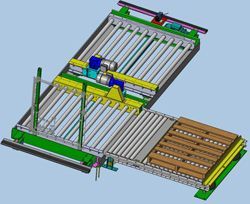
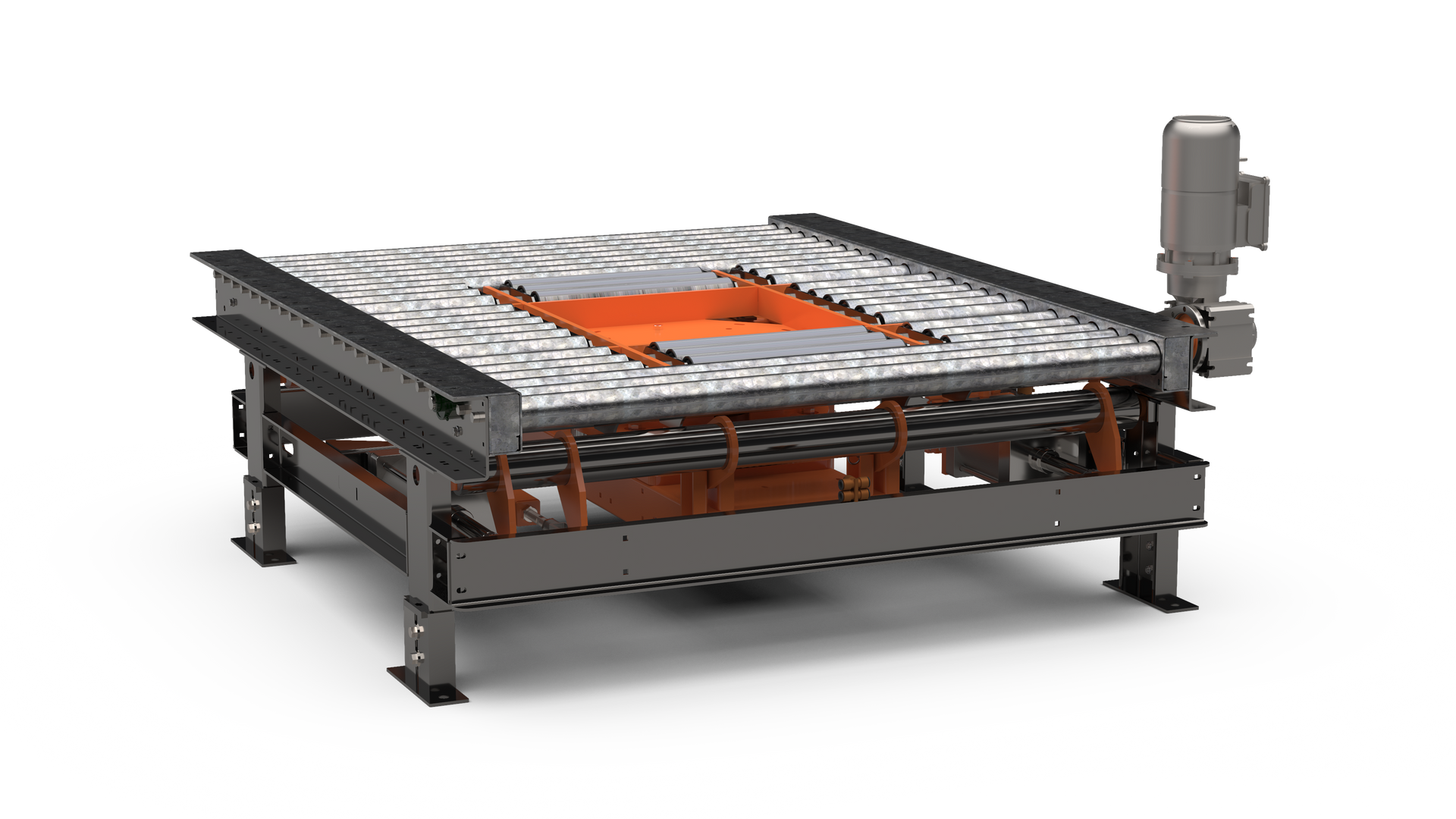
The Industrial Kinetics Turning Cross is an inline pallet-handling conveyor module designed to change the orientation of palletized or unitized loads relative to the direction of travel while maintaining controlled, predictable flow. Turning Cross units are used to rotate loads within a conveyor line to meet downstream orientation requirements without introducing secondary transfers or manual handling.
Industrial Kinetics Turning Crosses are engineered-to-order assemblies built around robust live-roller conveyor construction and proven rotating cross mechanisms. Multiple lift and rotation strategies are available, allowing each Turning Cross to be tailored to pallet size, load characteristics, and system layout.

Specifications
| Feature | Specification |
|---|---|
| Equipment Type | Turning Cross / Pallet Rotator Conveyor |
| Primary Function | Inline reorientation of palletized or unitized loads |
| Typical Rotation Angles | 90-degree orientation change; 180-degree orientation change; Continuous or indexed rotation up to 360 degrees (application dependent) |
| Conveying Surface | Single deck AMR topper, Side‑by‑side dual deck, Quad‑deck high‑capacity configuration |
| Frame Construction | Chain Driven Live Roller (CDLR) with crossover drive rollers through the rotating section |
| Frame Construction | Heavy-duty welded steel frame with integrated rotating cross assembly |
| Lift Method | Pneumatic lift for intermittent or fixed-angle rotation; Motor-driven lift for higher loads or precise vertical control |
| Rotation Method | Motor-driven rotation using geared drives for controlled indexing or continuous motion; Pneumatic cylinder-driven rotation for fixed-angle reciprocating applications |
Controls
- PLC-based control system coordinating lift, rotation, and conveyor sequencing
- Motor starters or VFDs for lift and rotation drives where electric actuation is used
- Solenoid valve manifolds for pneumatic lift or rotation configurations
- Proximity sensors for lift position (up/down) confirmation
- Rotational position sensing for accurate indexing and repeatability
- Photoeyes for pallet presence, release, and system interlocking
- Safety-rated E-stop circuits and guarded rotating components
Load Capacities
- Designed for palletized and unitized loads typical of automated pallet handling systems
- Load capacity is dependent on:
- Pallet footprint and weight distribution
- Required rotation angle and cycle rate
- Lift height and selected rotation mechanism
- Each Turning Cross is engineered to match the specific load and duty cycle of the application
Options
- Integrated lift-and-rotate designs that isolate the pallet above adjacent conveyor rollers prior to rotation
- Motor-driven rotation for precise angular control and repeatable positioning
- Pneumatic 90-degree reciprocating Turning Cross configurations
- Heavy-duty roller construction or reduced roller spacing through the rotating section
- Corrosion-resistant or stainless steel construction for demanding environments
- Safety guarding packages and access-controlled enclosures
Non-Standard Features
- Custom rotating cross geometries for oversized or нестandard pallets
- Dual-direction rotation capability within a single unit
- High-torque rotation assemblies for large pallet footprints
- Provisions for alignment sensors or downstream equipment confirmation
Why Choose Us
Industrial Kinetics Turning Crosses are built on decades of experience designing pallet-class live roller conveyor equipment. Rather than offering a single standard mechanism, Industrial Kinetics applies multiple proven lift and rotation architectures to best match the application. Heavy structural frames, controlled lift-and-rotate sequencing, and integrated sensing result in reliable pallet orientation with minimal system disruption.
Each Turning Cross is engineered as part of the overall conveyor system, ensuring compatibility with adjacent CDLR sections, accumulation zones, and automated equipment.
success stories
System Integration
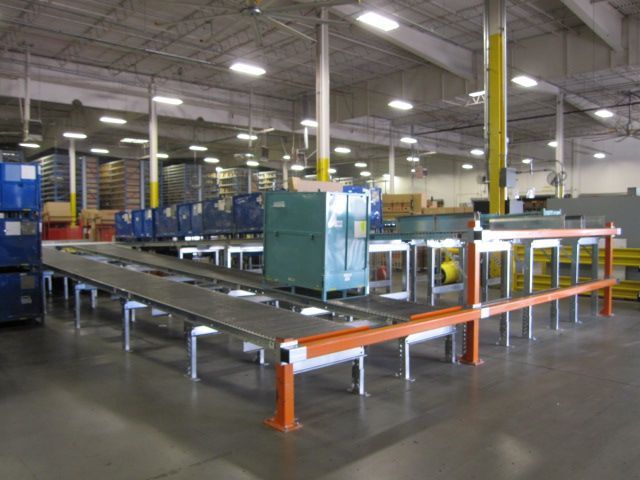
Turning Cross conveyors are designed to integrate directly into chain driven live roller conveyor systems. Lift, rotation, and conveyor operation are sequenced through the control system to ensure smooth load transfer and accurate positioning. Turning Crosses are commonly paired with accumulation conveyors, transfers, and palletizing equipment as part of fully automated pallet handling systems.
What industries typically use these systems:
01
Manufacturing: Reorienting pallets between sequential production or assembly processes
02
Palletizing Systems: Aligning pallets for palletizers, depalletizers, or robotic interfaces
03
Warehousing & Distribution: Adjusting pallet orientation to match storage or shipping lanes
04
Automotive & Heavy Industry: Handling large, heavy palletized loads within constrained layouts
Frequently Asked Questions
How does a Turning Cross differ from a turntable?
A Turning Cross is an inline conveyor module that maintains pallet support on live rollers while reorienting the load, rather than transferring the pallet onto a separate rotating platform.
Is the pallet lifted during rotation?
Many Turning Cross designs lift the pallet slightly above adjacent conveyor rollers to isolate the load before rotation. The lift method and height depend on the configuration.
What rotation angles are supported?
Turning Cross units can be designed for fixed 90-degree or 180-degree rotation, or for indexed or continuous rotation up to 360 degrees.
What determines whether pneumatic or motor-driven rotation is used?
The choice depends on pallet weight, required rotation accuracy, duty cycle, and system control requirements.
Are Turning Crosses custom engineered?
Yes. Each Industrial Kinetics Turning Cross is engineered to match the pallet dimensions, load characteristics, and layout of the conveyor system.
Request a Quote. Start Your Project Today
2535 Curtiss St.
Downers Grove, IL 60515
Phone: (630) 655-0300
Fax: (630) 655-1720
Turning Cross Conveyor (Pallet&Unitized Loads) Contact Form
We will get back to you as soon as possible.
Oops, there was an error sending your request. Please try again later.