Chain Driven Live Roller (CDLR) vs. Drag Chain Conveyors
Industrial Kinetics
May 4, 2026
Chain Driven Live Roller (CDLR) and drag chain conveyors are two of the most common unit load conveyor types used to move pallets through a facility.
The key difference comes from how the load is supported and how motion is transferred. CDLR conveyors move pallets across driven rollers. Drag chain conveyors carry the load directly on strands of chain. That difference affects how force is applied, how loads behave in motion, and how the system manages accumulation and flow.
Selection starts with the pallet — its condition and how its bottom boards are oriented to flow are the dominant criteria. Pallet weight, throughput, accumulation behavior, and operating environment then narrow the choice further. These factors also affect layout, controls, and how the conveyor interfaces with pallet handling systems, including palletizers, stretch wrappers, robotic cells, and Automated Storage and Retrieval Systems (AS/RS).
The right choice depends on understanding how each conveyor handles load, flow, and the realities of the operating environment.
What Is a Chain Driven Live Roller (CDLR) Conveyor?
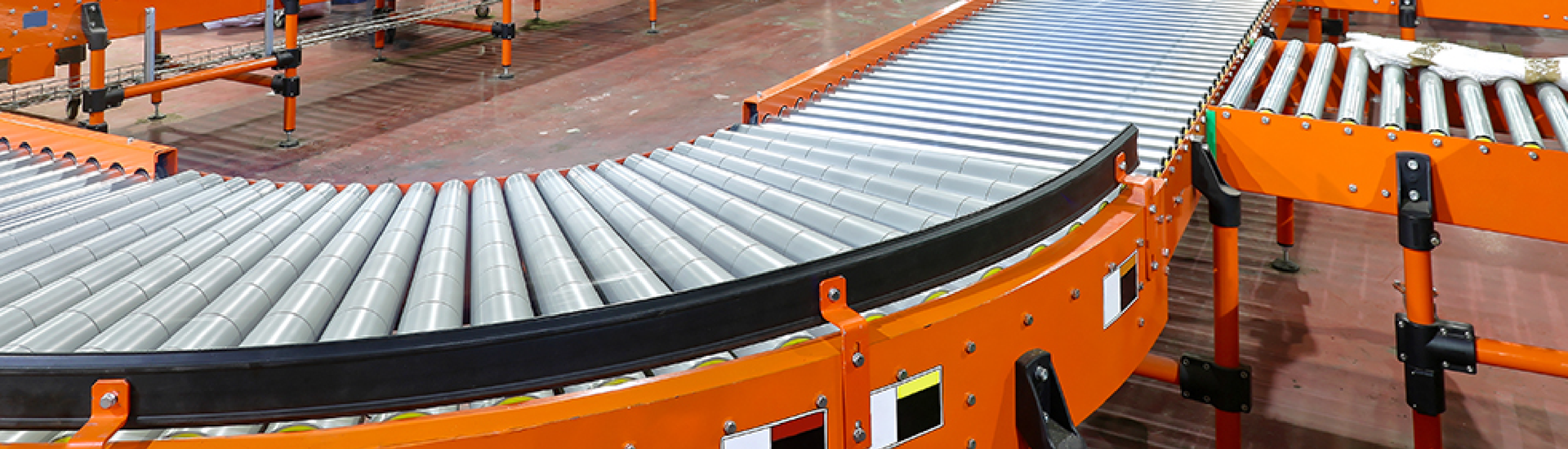
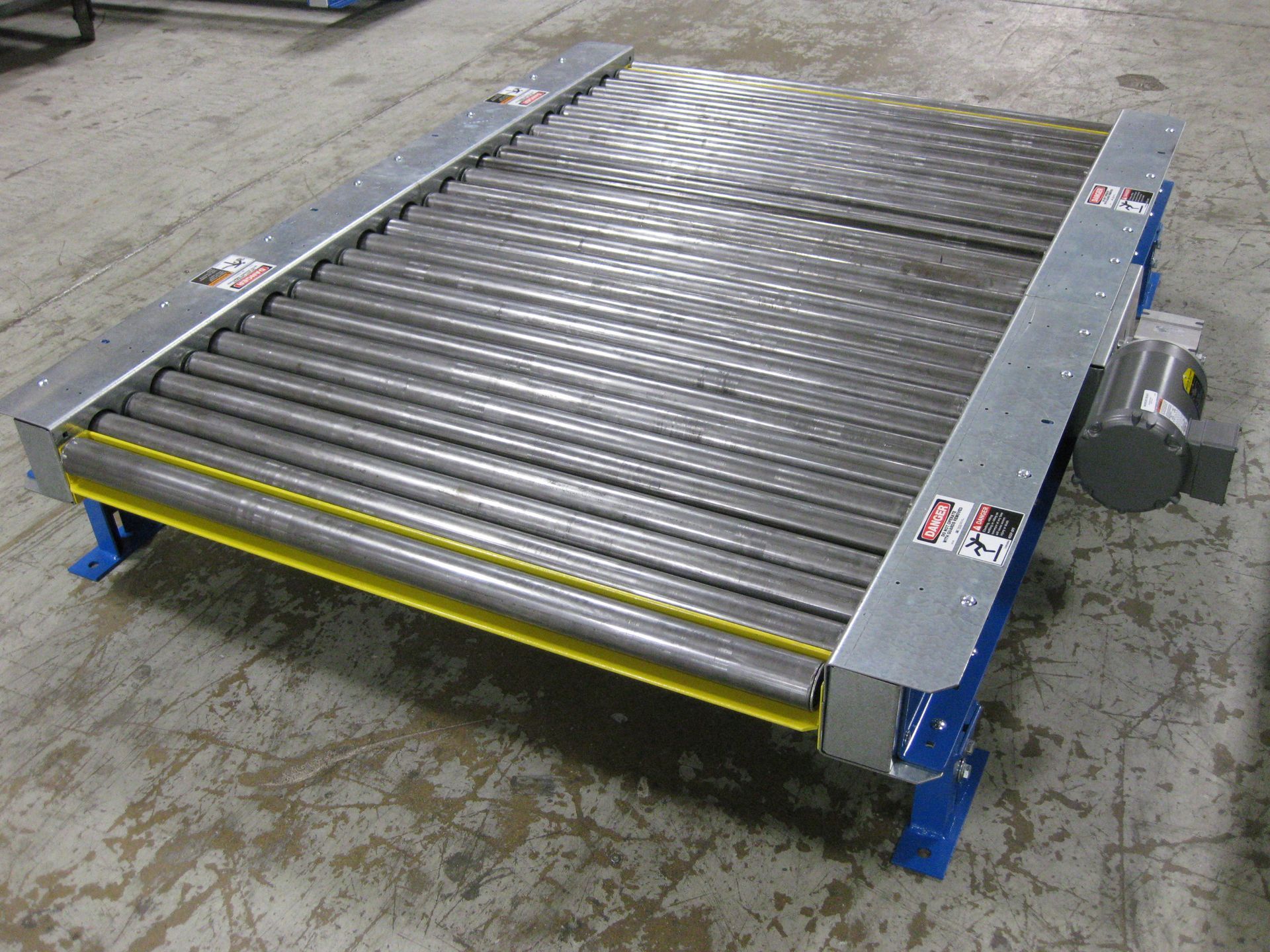
A Chain Driven Live Roller (CDLR) conveyor is a powered roller conveyor that uses chains to transmit torque from a drive assembly to a series of rollers.
Each roller is driven through sprockets and chain. When the drive rotates, the chain turns multiple rollers along the conveyor section, and those rollers move the pallet through surface contact with the bottom of the load.
Roller construction varies by manufacturer. Industrial Kinetics uses a sprocket plug design, which holds the sprocket concentric to the bearing and maintains accurate sprocket centers and squareness across the roller. This supports consistent chain engagement and reduces uneven wear over the life of the conveyor.
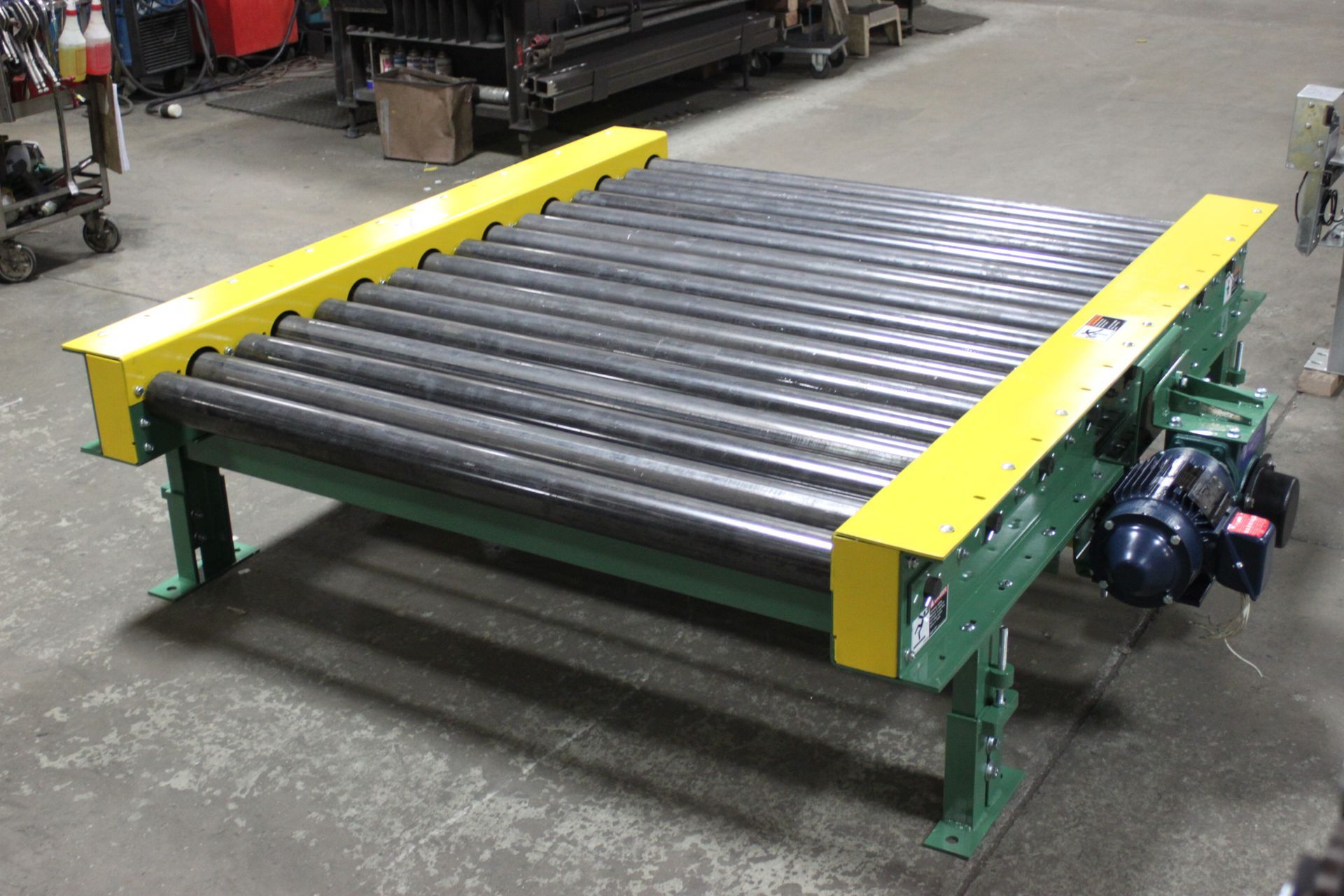
Because the load rolls rather than slides, resistance is low, and drive force is used efficiently. This reduces motor sizing and power consumption compared to a drag chain conveyor of equivalent capacity.
CDLR systems are commonly configured in zones. Each zone contains a set of rollers, a drive, and sensors that detect pallet presence. Zone controls use this feedback to release pallets forward or hold them in place, allowing loads to queue without contact and advance based on downstream availability.
This type of conveyor is typically used in applications that require:
- Pallets oriented with deck boards parallel to flow (GMA, CHEP, PECO)
- Controlled accumulation between process steps
- Consistent pallet spacing for downstream equipment
- Repeatable starts and stops at defined positions
Performance depends on pallet condition. Flat, stable bottom decks allow rollers to maintain consistent contact, which supports even motion across zones. Irregular or damaged pallets reduce contact area and can lead to uneven movement or loss of traction.
What Is a Drag Chain Conveyor?
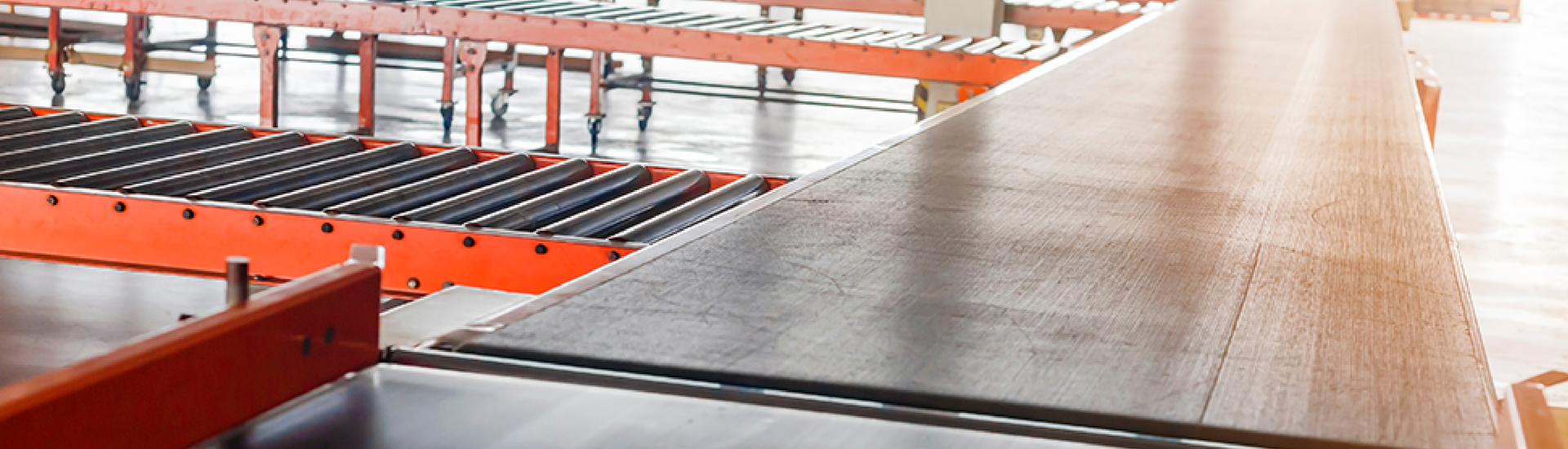
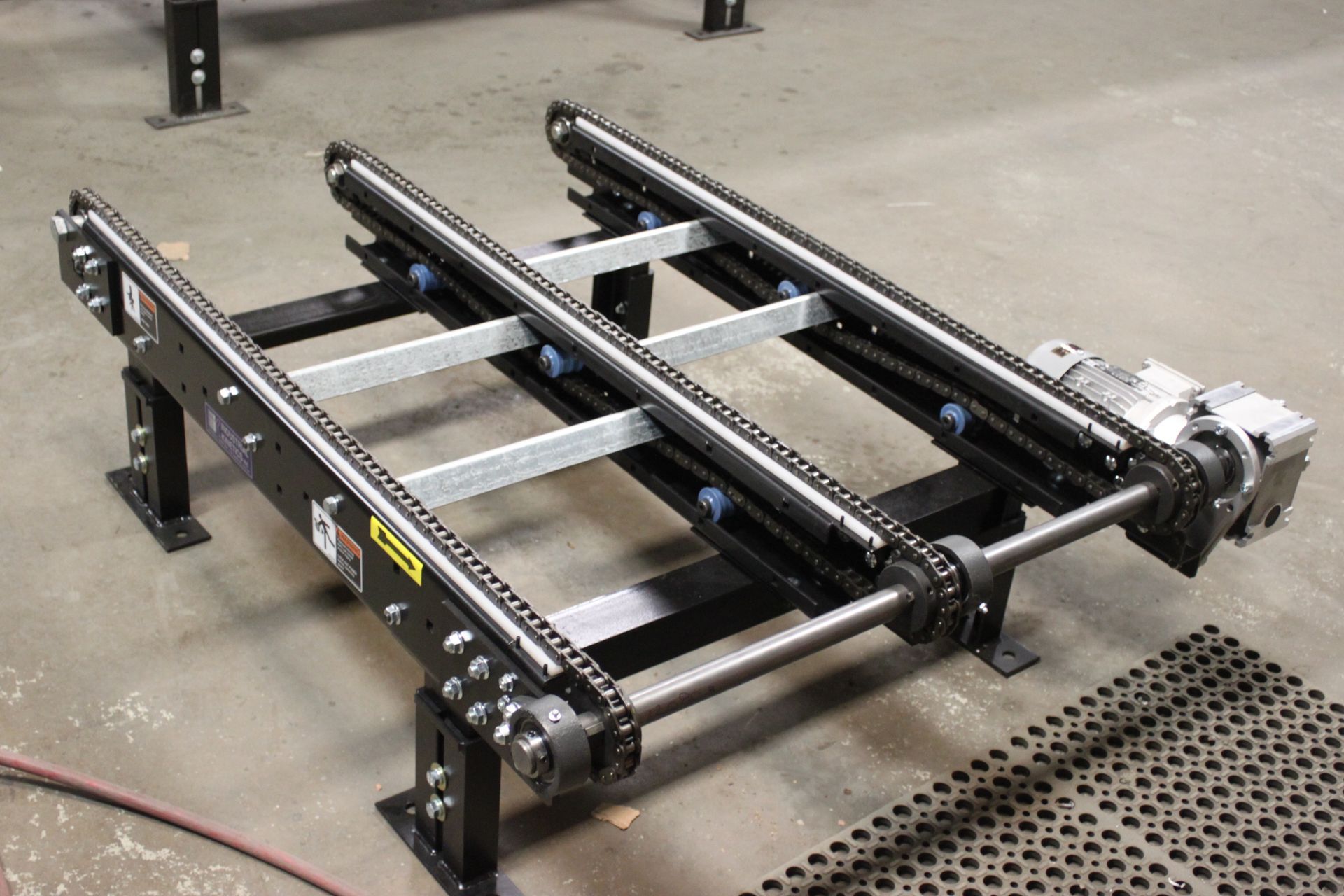
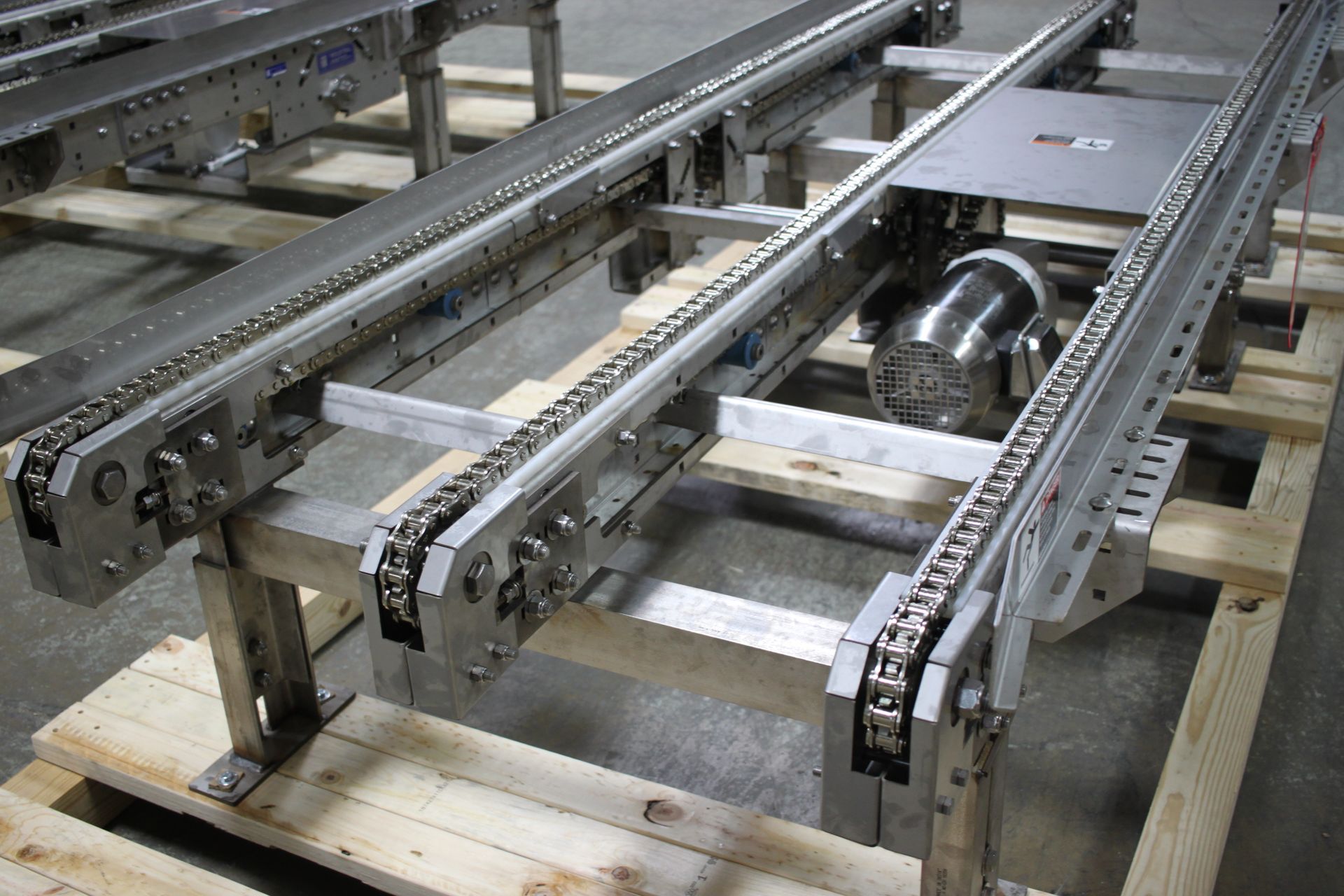
A drag chain conveyor uses strands of chain to carry loads along a fixed path. The chains run in a continuous loop between drive and take-up sprockets, with the load riding directly on top of the moving chains. Drives can be located at the head end or at an intermediate point along the conveyor, depending on length, layout, and access requirements.
In pallet handling applications, this is typically configured as a multi-strand chain conveyor. Two or more parallel chains are spaced to align with the pallet stringers or support points. The number and spacing of strands depend on pallet size, weight, and load distribution.
Because the pallet rides directly on the chains, movement does not rely on friction between a roller and the load. The chains pull the pallet forward through direct contact, which allows the system to move loads that would not travel consistently on a roller conveyor.
Drag chain is well suited to pallets running with deck boards perpendicular to flow — sometimes called moving a pallet "the hard way." In this orientation, rollers would contact only the deck boards, which can deflect under load or hang up between rollers if roller centers exceed deck board spacing. Drag chain avoids this by supporting the pallet along its stringers, which carry the full length of the load.
Typical applications include:
- GMA, CHEP, or PECO pallets oriented with deck boards perpendicular to flow
- Heavy pallet transport with high load weights
- Pallets or skids with poor or variable bottom conditions
- Environments where debris or buildup would interfere with roller rotation
- Straight conveyor sections between process steps
Drag chain conveyors are typically applied in continuous conveying sections. The conveyor runs, and all loads on that section travel together at the same speed. Accumulation is most often handled by segmenting the conveyor into multiple drive sections, with each section running independently to stage loads. Transfers placed along the line can also be used to route or shift loads between sections.
This conveyor type is used when load stability and continuous forward movement take priority — particularly in conditions where roller contact with the pallet bottom would be inconsistent.
Core Mechanical Differences
The differences between CDLR and drag chain conveyors show up in how force is applied to the load and how that force behaves under real operating conditions.
CDLR systems transfer motion through rotating rollers. Multiple rollers contact the pallet bottom at any given time, distributing the work of moving the load. Resistance comes from the rolling friction of the roller bearings, which is low — typical design friction factors fall in the range of 4-6% of load weight. That efficiency reduces the drive force, motor size, and energy consumption required to move a given load.
Drag chain conveyors support the pallet directly on the chain strands, and the drive pulls the chain — and everything on it — forward. The chain is supported either on a UHMW wearstrip, where the chain sidebars slide on plastic, or on a steel wearstrip configured for the chain's own rollers to ride on. Sliding chain on UHMW typically runs at design friction factors of 25-35%; roller chain on steel rail runs lower, in the range of 10-15%. The force required to move the load and chain together is referred to as
chain pull, and it drives chain selection.
Two engineering checks govern drag chain sizing:
- Chain pull vs. chain working load. Chain pull accumulates along the length of the conveyor — every load on the chain adds to the pull at the drive. The total must stay within the chain's maximum allowable working load.
- Point loading vs. chain vertical capacity. The weight resting on the chain at any one point must not exceed the chain's vertical load capacity, which is governed by the chain rollers and bushings.
These differences shape system behavior in several ways:
Rolling friction vs. direct drive. CDLR moves the load through rolling contact between the rollers and the pallet bottom. Drag chain moves the load through direct mechanical engagement — the chain physically carries the pallet forward.
Sensitivity to load condition.
Variations in pallet bottom quality affect CDLR performance because the system depends on consistent roller contact. Drag chain conveyors maintain movement even when pallet conditions vary, since the load rides on the chain rather than being pushed by surface friction.
Force distribution.
CDLR spreads drive force across many rollers along the conveyor. Drag chain concentrates force along the chain path, which is why chain selection, wearstrip support, and chain pull calculations are central to drag chain design.
Length and capacity scaling.
CDLR systems can be extended by adding driven zones, each carrying its own portion of the load. Drag chain length is constrained by cumulative chain pull — longer runs and heavier loads require larger chain or segmented drive sections.
Accumulation and Throughput Behavior
CDLR conveyors are commonly designed for controlled accumulation. The most precise approach is single-zone accumulation, where the conveyor is divided into zones that each hold a single pallet. Zone controls manage when pallets advance based on downstream availability, allowing loads to queue without contact and release in sequence. This non-contact accumulation protects loads from impact damage — a meaningful consideration for stretch-wrapped pallets, fragile products, or unstable loads.
Slug accumulation is another option, and it can be applied to either CDLR or drag chain conveyors. In a slug arrangement, the conveyor is divided into multiple drive sections — typically three or more — with each section carrying 1-4 pallets at a time. Loads accumulate as a group within a section and release together to the next. Slug systems are best suited to applications with lower flow rates (measured in pallets per hour) but a need to stage a large number of pallets in a compact footprint — for example, buffering ahead of a stretch wrapper, between shifts, or upstream of a shipping operation. Because each section moves multiple loads, horsepower, chain pull, and throughput all need to be evaluated against the loaded weight of the section, not just a single pallet. Industrial Kinetics' Power Roller Accumulation Conveyor Guide walks through how these systems function.
Drag chain conveyors without slug accumulation move pallets in continuous flow — all loads on a section travel at the same speed while the conveyor is running. Where staging is needed, segmenting the conveyor into multiple drive sections allows groups of loads to advance independently. Transfers placed along the line can also route or stage loads between sections.
These differences affect system behavior:
- Single-zone CDLR allows non-contact buffering with pallet-by-pallet release, which supports higher per-pallet throughput and protects loads in process
- Slug accumulation, on either CDLR or drag chain, stages loads in groups — best suited to lower-velocity flows where a large number of pallets need to be accumulated in a compact footprint
- Continuous-flow drag chain relies on steady movement, with staging handled at the boundaries between drive sections
Throughput in single-zone CDLR systems is tied to zone control and release timing, which lets throughput flex with downstream demand. In slug systems, throughput is governed by section length, pallets per section, and section cycle time — and is generally better suited to buffering capacity than to high pallet-per-hour rates. In a continuous-flow drag chain, throughput is set by conveyor speed and changes only when line speed changes or drive sections are cycled.
Load Type and Pallet Considerations
Load type and pallet construction play a major role in selecting between CDLR and drag chain conveyors.
CDLR conveyors depend on consistent contact between the rollers and the pallet bottom. Pallets need a relatively flat, stable surface so that multiple rollers engage at the same time — as a general rule, at least three rollers should be under the load at all times. Standard stringer pallets in good condition (GMA-style) and block pallets (CHEP, PECO) both convey predictably on CDLR when bottom decks are sound, supporting controlled accumulation and smooth transitions.
Pallet construction, dimensions, and performance criteria are governed by ANSI MH1, Pallets, Slip Sheets, and Other Bases for Unit Loads, maintained by MHI. The standard includes specific provisions for pallets intended for use in automatic unit-load material handling systems — covering construction, materials, and performance criteria for pallets running on conveyors, AS/RS, and other automated equipment. In practice, conveyor and AS/RS suppliers typically issue an application-specific pallet specification — referencing MH1 as the baseline and adding tighter requirements for flatness, deflection under load, and deck board spacing — to ensure consistent conveyability.
Irregular pallets introduce challenges. Broken boards, missing deck sections, or uneven spacing can reduce roller contact. That can lead to slipping, uneven movement, or pallets stalling within a zone.
Drag chain conveyors are less sensitive to these conditions. The chains engage the pallet at defined points — typically along the stringers on stringer pallets, or under the bottom deck boards or blocks on block pallets. Even when the bottom surface is inconsistent, the load can still move forward because it rides on the chain rather than depending on distributed roller contact.
Load weight and distribution also affect performance. CDLR systems distribute load weight across multiple rollers, and roller capacity, bearing rating, and roller center spacing are sized to the application. Drag chain conveyors carry load along the chain strands, so chain selection must account for both chain pull and the point loading on the chain at any one location. Off-center loads can shift weight onto one strand and need to be considered in chain sizing.
Drag chain also handles loads that don't fit standard pallet conventions — skids, slip sheets, custom fixtures, or non-conforming loads — more readily than CDLR, since the chain doesn't require a uniform conveying surface.
In applications where pallet quality is controlled and consistent, CDLR systems maintain predictable movement and accumulation. Where pallet condition varies or bottom decks are unreliable, drag chain conveyors provide more consistent movement across those variations.
Environmental and Operating Conditions
Operating conditions affect both conveyor types and need to be accounted for in design and specification. Debris, lubrication, temperature, washdown requirements, and accessory selection all factor into how a system performs over time.
Debris and contamination.
Both CDLR and drag chain conveyors are sensitive to harsh or dry environments, but the wear mechanisms differ. In CDLR systems, grit and inadequate chain lubrication in the roller-to-roller drive chain accelerate chain and sprocket wear and increase chain pull, which can lead to premature drive component failure. In drag chain systems, abrasive contamination between the chain and wearstrip accelerates wear on both. Neither conveyor type is inherently "cleaner" — the right answer depends on where the wear is more manageable in the specific application, and both benefit from proper lubrication and a maintenance program suited to the environment.
Temperature.
Temperature affects the chain working load capacity for both conveyor types. Chain manufacturers publish derating factors based on operating temperature; capacity drops at both low and high extremes. As a practical example, working load is typically derated to about 25% of catalog rating at -20°F, 30% at -4°F, full rating at 15-300°F, 75% at 300°F, and 50% at 390°F. Industrial Kinetics generally does not specify standard chain conveyors for service above 180°F; higher-temperature applications require purpose-built designs.
Cold storage and freezer service.
Sub-freezing environments call for specific changes in lubrication across the drive train — reducers, mounted bearings, and conveyor roller bearings all need lubricants rated for the operating temperature range. Pallet condition also tends to degrade in freezer service, with frozen condensate and ice buildup affecting bottom-deck contact on roller-supported conveying. As a design rule, air-operated accessories — stops, pushers, transfer actuators — should be avoided in or near freezing conditions. Moisture in pneumatic lines can freeze and disable the device. Electric or hydraulic actuation is preferred in these applications.
Washdown and sanitation environments.
Food, beverage, and pharmaceutical applications where the conveyor is washed down regularly are addressed through material selection and component specification rather than conveyor type. Stainless steel framing, sealed bearings rated for washdown, washdown-rated motors and reducers, and lubricants compatible with the cleaning regimen all factor into the design. Either CDLR or drag chain can be configured for washdown service when specified appropriately. One important engineering consideration: stainless steel roller chain — used in either the roller-to-roller drive of a CDLR conveyor or as the conveying chain in a drag chain conveyor — is rated for significantly lower working loads than carbon steel chain. Standard 304 stainless RC50 through RC100 chain typically carries only 25-33% of the working load of equivalent carbon steel chain, because the components cannot be heat-treated to the same hardness. This often requires upsizing the chain, adding strands, or both, to achieve the same load capacity in stainless. Hardened stainless and specialty corrosion-resistant alloys can recover some of the working load, but a one-for-one swap from carbon to stainless will always reduce capacity.
Impact loading.
Fork truck drop-offs, pallets dropping from stackers or lifts, and side loading from transfers introduce shock loads to the conveyor. Roller bearings in CDLR systems are sensitive to shock loading; applications with repeated impact are typically addressed with heavier-duty rollers, closer roller centers, or both. Drag chain handles vertical impact more readily, since the chain and supporting rails are inherently more tolerant of shock loads than roller bearings.
The operating environment should be defined early in the design process. Temperature range, contamination sources, washdown requirements, and impact conditions all affect component selection, materials, and accessory choices — and in many cases narrow the practical conveyor options before the CDLR-versus-drag-chain question is even on the table.
Layout and System Integration Considerations
Conveyor selection drives how the system is laid out and how it interfaces with surrounding equipment.
CDLR. Zone-controlled CDLR is well-suited to layouts where pallets need to stop, queue, and release at defined points. Consistent spacing supports handoffs to palletizers, stretch wrappers,
robotic cells, and
AS/RS infeeds. The zone structure also supports common pallet handling features — 90-degree chain or wheel transfers, merges and diverts, turntables, and right-angle direction changes — without disrupting the overall flow, since transfers can be inserted between zones.
Drag chain.
Drag chain conveyors fit straight sections between process points where pallets move together at the same speed. Positioning and staging are handled by segmenting the conveyor into multiple drive sections, with transfers placed along the line where direction changes or routing is required.
Pallet orientation changes. Many
pallet handling layouts require changes in orientation between processes — receiving stringer-leading off a forklift, transitioning to deck-board-leading for a stretch wrapper, then changing again before shipping. Turntables, right-angle transfers, and mixed CDLR / drag chain sections are commonly used to handle these transitions. CDLR may carry the pallet in one orientation, with the drag chain handling the orientation that doesn't convey well on rollers.
Maintenance access.
Layout planning should also account for service access. CDLR systems typically require side access to rollers, drives, and bearings. Drag chain typically requires end access for chain removal and take-up adjustment. Layouts that crowd conveyors against walls, columns, or other equipment can complicate maintenance and should be reviewed during design.
In practice, applications requiring controlled spacing, multiple routing points, or buffering align with CDLR. Straight transport between process steps with fewer control points aligns with the drag chain. Most real-world systems combine both, using each conveyor type for the section where it performs best.
Lifecycle Cost and Maintenance Tradeoffs
Lifecycle cost depends on how each system wears and how maintenance is handled over time.
CDLR conveyors have more moving parts across the conveying surface. Maintenance is distributed across rollers, bearings, and chains:
- Roller and bearing wear over time
- Chain lubrication requirements
- Periodic sprocket and drive inspection
Drag chain conveyors concentrate wear in fewer components. Maintenance focuses on the chain path and drive system:
- Chain stretch and wear
- Wear strip replacement
- Chain tensioning and lubrication
Operating conditions and duty cycle drive service intervals for both. CDLR systems spread wear across many components, which can lead to more frequent but smaller maintenance tasks. Drag chain systems focus wear in fewer areas, which can reduce routine touchpoints but may require more intensive service when components reach the end of life.
When to Use CDLR vs. Drag Chain (Application Guide)
Selection depends primarily on pallet condition and pallet bottom-board orientation. After those two criteria, secondary factors — accumulation requirements, layout, environment, and length — narrow the choice further.
For over 55 years, Industrial Kinetics has designed and manufactured conveyors to CEMA standards. The CEMA Application Guide for Unit Handling Conveyors, 2nd Edition, is the industry-recognized reference for conveyor design, application, and safety in this category, and informs the engineering practices reflected throughout this article.
Pallet condition and orientation drive the decision.
CDLR works well when pallets are in good condition (conforming to ANSI MH1) and oriented with deck boards parallel to flow — the rollers contact each board continuously along its length, and the load conveys predictably. Drag chain works well when pallets are damaged, inconsistent, or oriented with deck boards perpendicular to flow ("the hard way"), since the chains engage along the stringers or under the blocks rather than depending on roller contact with the deck boards.
If pallet condition is mixed or unpredictable across a single facility, drag chain handles the variability more reliably. If pallet condition is controlled and consistent, CDLR opens up more options downstream.
Cost and efficiency depend on conveyor length and zone configuration.
For single-zone conveyors with roller centers of 4-1/2" or greater, CDLR is typically lower cost and more efficient than a drag chain. The rolling friction of a CDLR is significantly lower than the sliding friction of a drag chain, which reduces drive horsepower and energy consumption. For shorter runs and discrete zones, CDLR is often the more economical choice.
For long, continuous-run conveyors, a drag chain is typically lower cost. A drag chain section can run on a single drive across a long span, while CDLR over the same distance requires multiple driven zones and more drive components per linear foot.
Use CDLR when:
- Pallets are in good condition with consistent bottoms (GMA, CHEP, or PECO conforming to ANSI MH1)
- Pallets are oriented with deck boards parallel to flow (stringer-leading)
- Non-contact accumulation and pallet-by-pallet release are required
- Repeatable positioning is needed for downstream equipment (palletizers, stretch wrappers, robotic cells, AS/RS infeeds)
- The layout includes multiple transfers, turntables, merges, or routing paths
- The conveyor is single-zone or moderate length with roller centers of 4-1/2" or greater (typically lower cost and more efficient than drag chain at this scale)
Use drag chain when:
- Pallets have poor, damaged, or variable bottom conditions
- Pallets are oriented with deck boards perpendicular to flow ("the hard way")
- Loads are heavy or include skids, slip sheets, custom fixtures, or non-standard bases
- Flow is straight and continuous over a long distance (typically lower cost than CDLR over long runs)
- The application includes impact loading from forklift drop-offs, lift descents, or side loading
- A lower top-of-conveyor elevation is needed for forklift drop-offs or floor-level operator stations
Use slug accumulation (on either CDLR or drag chain) when:
- A large number of pallets need to be staged in a compact footprint
- Flow rates are modest (pallets per hour), and pallet-by-pallet separation isn't required
- Common applications include buffering ahead of a stretch wrapper, between shifts, or upstream of shipping
Most real-world systems use both CDLR and drag chain. A typical layout might use drag chain at a forklift drop-off where pallet condition is variable, then transition to CDLR for accumulation upstream of a stretch wrapper, palletizer, or AS/RS infeed. Industrial Kinetics designs these hybrid layouts as a standard part of pallet handling system engineering.
Conveyor type, layout, and controls are developed together to match the application — pallet condition, throughput, accumulation requirements, operating environment, and integration with downstream equipment; all factors into the design. For projects involving mixed pallet conditions, automation interfaces, or complex layouts, discussing the application early in the design process helps align the system with how it will operate in production.
Contact Industrial Kinetics to walk through your application with an engineer or request a quote.
Our Recent Insights