Heavy Duty Pallet Handling Systems & Design
Industrial Kinetics
March 30, 2026
Heavy-duty pallet handling systems are engineered conveyor systems designed to move, accumulate, and position palletized loads under defined operating conditions. System design is driven by load characteristics, throughput targets, accumulation behavior, and interface requirements with upstream and downstream equipment.
When these factors are addressed early in pallet system design, flow remains stable, accumulation stays controlled, and performance stays consistent across the material handling process.
What Is a Heavy Duty Pallet Handling System?
A heavy-duty pallet handling system is an engineered conveyor system that moves, accumulates, and positions palletized loads through a facility in a controlled way. It combines conveyors, transfers, and control logic to manage how pallets move and interact with downstream equipment.
System design starts with the load. Pallet weight, size, and bottom deck condition affect how the conveyor applies force and supports the product. These factors influence conveyor selection, drive requirements, and accumulation strategy.
A complete system typically includes conveying sections, accumulation zones, transfers, and a conveyor PLC control system that coordinates movement and release timing. It operates as part of a larger process, often interfacing with Automated Storage and Retrieval Systems (ASRS), Automated Guided Vehicles (AGVs), Autonomous Mobile Robots (AMRs), and robotic cells.
Because of this, the system must maintain consistent spacing, stable accumulation, and accurate positioning across all operating conditions.
How Heavy Pallet Conveyor Systems Work
Heavy pallet conveyor systems move loads through a combination of mechanical drives and coordinated control logic. The focus is controlled movement, defined spacing, and repeatable positioning.
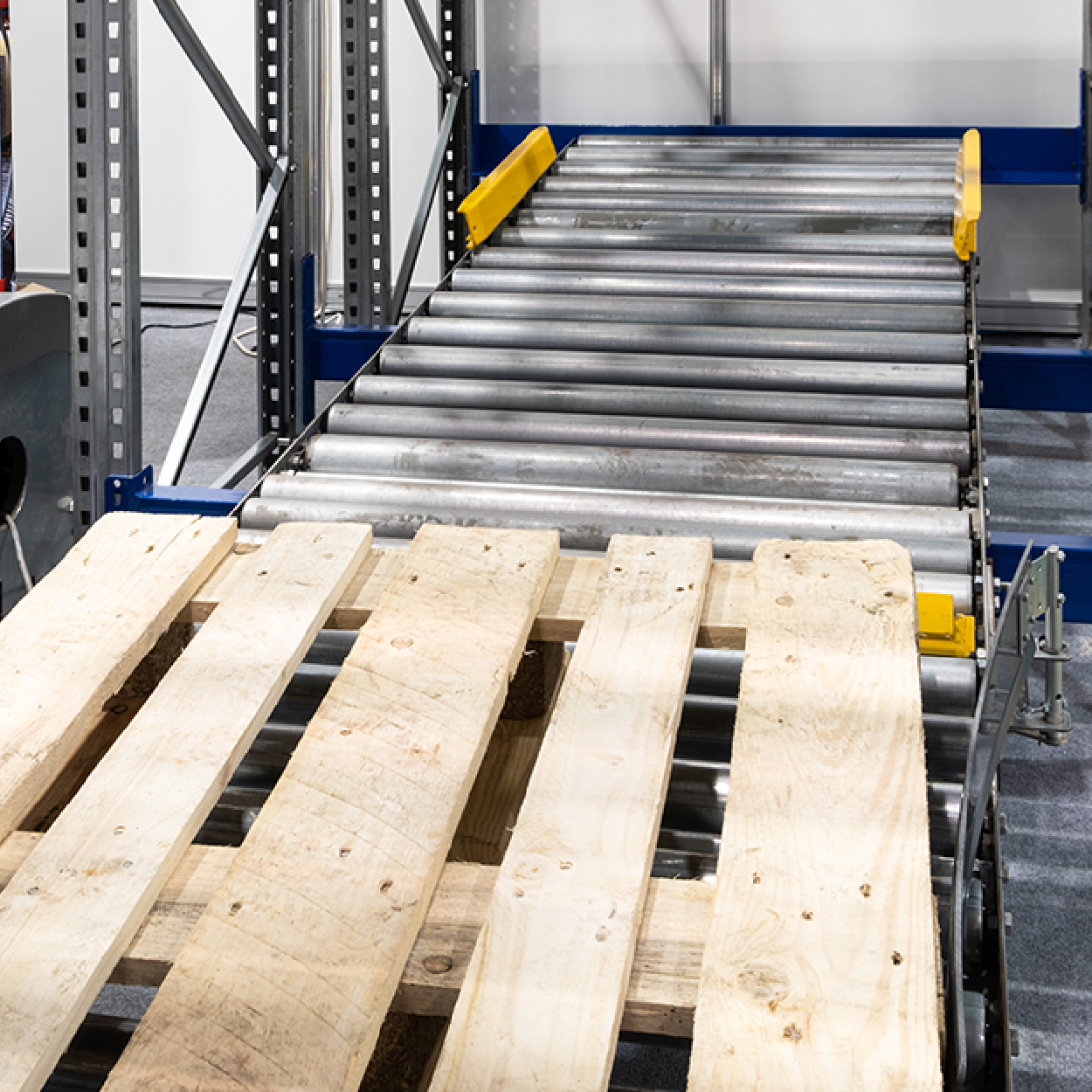
Pallets are conveyed using driven rollers or chains. A motor and drive assembly apply torque to move the load. In heavy applications, starting torque matters since the system must overcome static friction at each start.
Flow is managed through accumulation zones. Each zone holds a pallet without contact. Sensors detect presence, and the conveyor PLC control system controls release based on downstream availability.
Transfers and positioning devices manage direction changes and placement. Common examples include:
- Right-angle transfers
- Lift-and-locate stations
- Stops for downstream operations
The system operates as a coordinated sequence. Movement and release timing are tied to downstream conditions and accumulation limits. This allows consistent spacing and reliable handoffs to palletizers, wrappers, and ASRS interfaces.
Key Design Inputs for Heavy Duty Pallet Handling Systems
Heavy-duty pallet handling systems are designed around a defined set of inputs that drive equipment selection and system behavior.
Key inputs include:
- Load characteristics: weight, size, and pallet condition
- Throughput: pallets per hour and required flow rate
- Accumulation behavior: how pallets queue and release
- Duty cycle: start-stop frequency and operating hours
- Layout constraints: space, routing, and elevation changes
- Environmental conditions: temperature, debris, washdown
- Automation interfaces: ASRS, AGVs, AMRs, and robotics
These factors are interdependent. Changes in one area, such as higher throughput or heavier loads, directly affect drive requirements, accumulation strategy, and overall system layout.
Conveyor Types Used in Heavy Pallet Handling Applications
Heavy pallet handling systems use several conveyor types, each suited to specific load conditions and accumulation requirements.
Common types include CDLR, multi-strand chain, drag chain, and slat conveyors. Selection depends on how the pallet is supported, how force is applied, and how the system needs to operate.
Chain Driven Live Roller (CDLR) Conveyor Systems
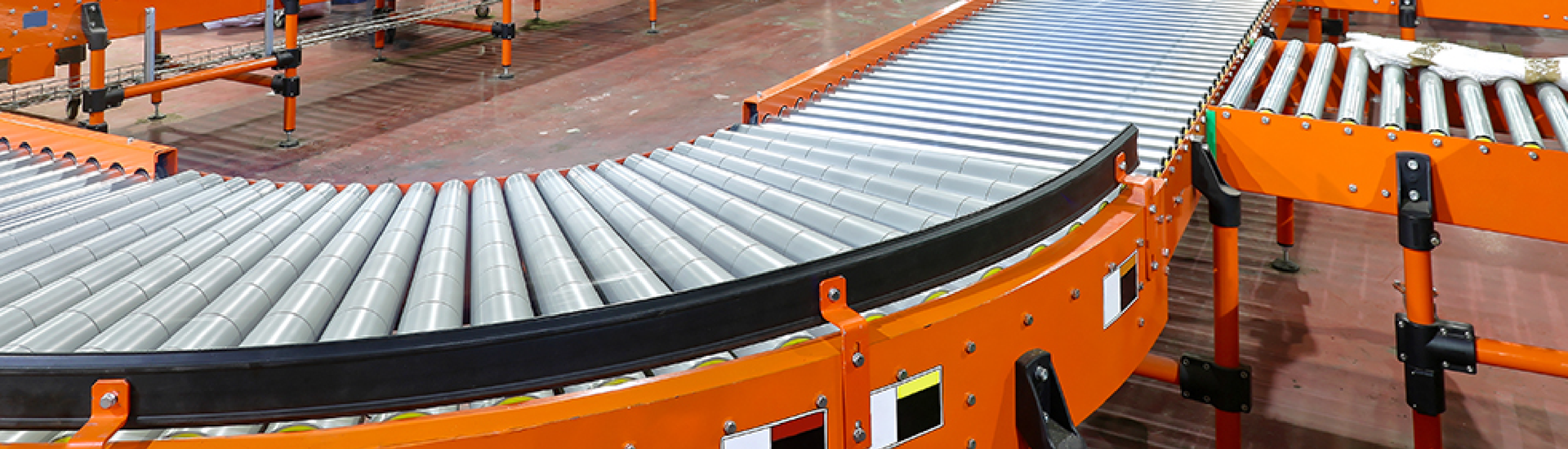
Chain Driven Live Roller (CDLR) conveyor systems use chains to drive rollers that carry the pallet. Torque is transmitted across multiple rollers to move the load.
Zone-based accumulation allows pallets to stop and release based on system conditions.
CDLR systems are used when pallets have consistent bottom surfaces and controlled accumulation is required.
Multi-Strand Chain or Drag Chain Conveyors
Multi-strand chain or drag chain conveyors use parallel strands of chain to carry the pallet directly, without rollers. The load rests on two or more chains, depending on pallet size and weight.
Heavier loads and pallets with inconsistent bottom surfaces often require this approach, since rollers may not maintain consistent contact. Performance remains stable in applications involving impact loading or harsh operating conditions.
Since the pallet moves directly on the chains, these systems are typically limited to straight transport and are not used for accumulation in the same way as CDLR systems.
Slat Conveyors for Heavy or Irregular Loads
Slat conveyors use a series of connected steel or composite slats mounted to chains to carry pallets or products. The slats create a continuous conveying surface rather than discrete contact points.
Heavy loads, unstable pallets, or products without a defined base benefit from this design. Full surface contact keeps loads steady during movement and reduces shifting during starts and stops.
Slat conveyors are used where pallet condition is inconsistent or where the load extends beyond standard pallet dimensions.
Transfer Cars
Transfer cars move pallets perpendicular to the primary conveyor flow, allowing loads to be routed across multiple parallel lines or between system segments.
A transfer car consists of a carriage mounted on rails with an integrated conveyor section. The carriage travels to a defined position, aligns with a fixed conveyor, and transfers the pallet on or off the car.
These systems are used when multiple infeed or discharge points need to be served without adding complex conveyor routing. They are also used to bridge gaps between system sections or to move pallets across aisles.
Positioning accuracy and repeatability are critical. The system must align consistently with adjacent conveyors to maintain stable transfers and prevent pallet shifting.
Turntables
Turntables rotate pallets to change orientation or redirect flow without requiring additional conveyor paths.
A turntable consists of a rotating platform with an integrated conveyor surface. The pallet is conveyed onto the platform, stopped, rotated to the required angle, and then released onto the next conveyor.
These systems are used to reorient pallets for downstream operations such as palletizing, wrapping, or robotic pickup. They are also used to change flow direction in compact layouts where right-angle transfers are not practical.
Rotation must be controlled and repeatable to maintain alignment with downstream equipment. Load stability during rotation is a key consideration, especially for tall or uneven loads.
Modular Plastic Belt Conveyors
Modular plastic belt conveyors use interlocking plastic belt segments to create a continuous conveying surface supported by a slider bed or rollers.
The belt provides full surface contact, allowing pallets or products to move across the conveyor without relying on discrete support points. This design is used when loads are unstable, irregular, or extend beyond standard pallet dimensions.
These conveyors are also applied in environments where washdown, corrosion resistance, or product contamination are factors. The belt construction allows for easier cleaning and resistance to moisture and chemicals.
Modular plastic belt conveyors are typically used for continuous flow applications and are not used for accumulation in the same way as CDLR systems.
When to Use Each Conveyor Type Based on Application Conditions
Conveyor selection depends on load condition and accumulation requirements:
- CDLR: controlled accumulation and consistent pallet bottoms
- Multi-strand chain or drag chain: heavy loads or poor pallet conditions
- Slat: unstable or irregular loads requiring full surface contact
- Transfer cars: Used to move pallets across multiple parallel conveyor lines or between system segments.
- Turntables: Used to change pallet orientation or redirect flow within compact layouts.
- Modular plastic belt: Used for continuous conveying of unstable or irregular loads, or in environments requiring washdown or corrosion resistance.
Selection is driven by how the pallet behaves and how the system needs to operate.
Pallet Handling System Layout and Flow Design
Layout defines how pallets move between process points.
Flow paths are arranged around production, storage, and shipping. Merges, diverts, and straight runs are placed to keep movement consistent and avoid congestion.
Accumulation is positioned ahead of slower operations to prevent backups. Routing accounts for maintenance access and future expansion.
Transfers, Positioning, and System Interfaces
Transfers and positioning devices control how pallets change direction and align with downstream equipment.
Common transfers include right-angle transfers and lift-and-transfer units. Positioning devices, such as stops and locates, hold pallets in place for operations like wrapping or robotic pickup.
System interfaces connect the conveyor to equipment such as palletizers,
automated load stackers and pallet inserters, stretch wrappers, and ASRS. These points require consistent pallet location and repeatable timing to maintain stable handoffs.
Integration with Automation Systems
Pallet handling systems are frequently integrated into larger automation environments.
Interfaces with Automated Storage and Retrieval Systems (ASRS), Automated Guided Vehicles (AGVs),
Autonomous Mobile Robots (AMRs), and robotic cells require defined handoff points and consistent positioning. Communication between systems is managed through the conveyor PLC control system, which coordinates movement and timing.
Integration influences conveyor layout, control logic, and positioning accuracy. Poor alignment at these interfaces can disrupt upstream and downstream operations.
Structural and Mechanical Design Considerations
Structural and mechanical design determine how the system handles load over time.
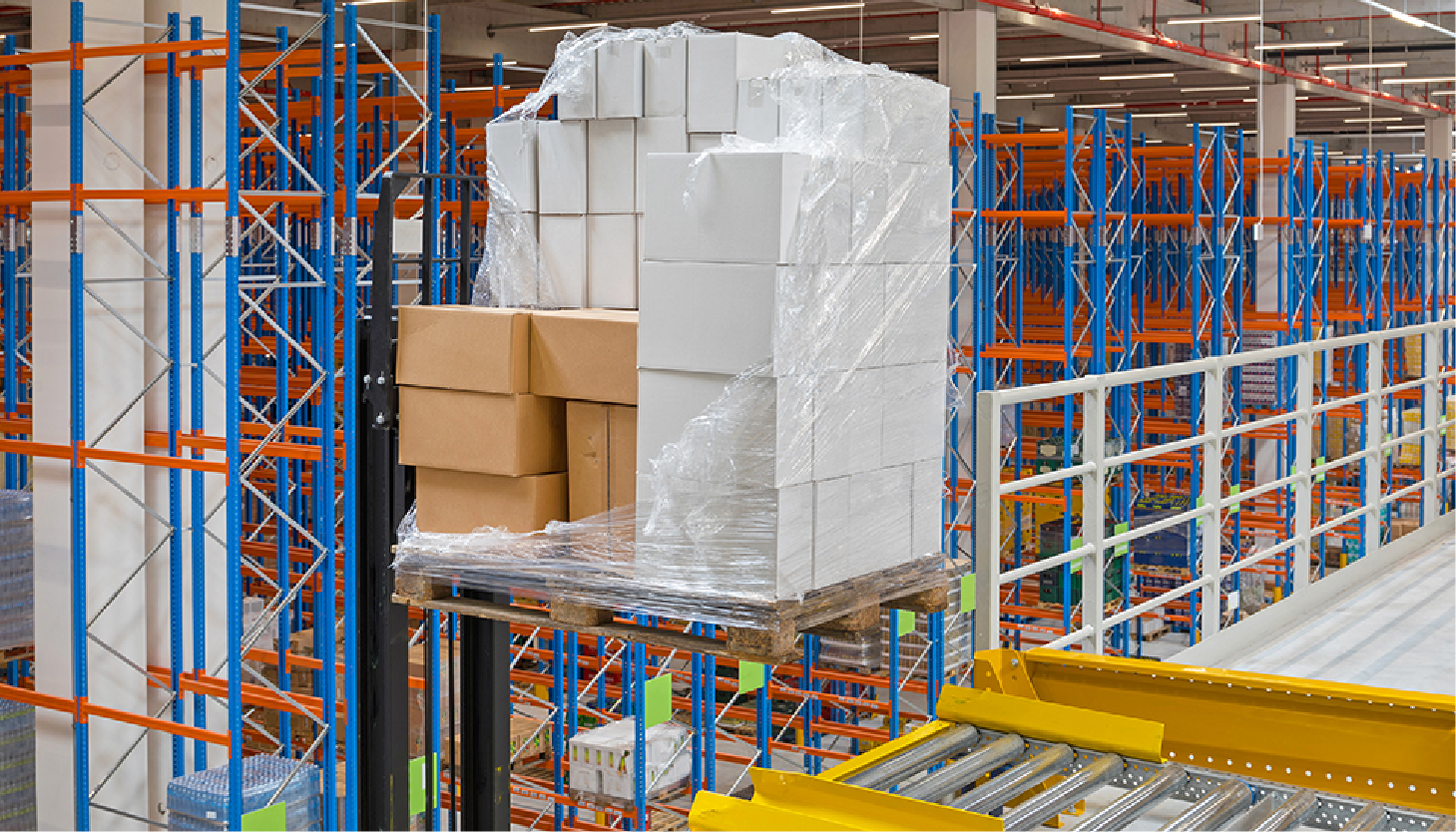
Frame construction is based on pallet weight, load distribution, and span between supports. Heavier applications require thicker members, reinforced frames, and stable anchoring to prevent deflection and misalignment.
Drive components are selected based on torque requirements and duty cycle. Chain size, bearing selection, and motor sizing all affect how the system starts, stops, and maintains motion under load.
Mechanical design also accounts for wear. Access to chains, rollers, and drive components affects maintenance time and long-term performance.
Designing for Uptime and Serviceability
Design decisions directly affect how the system performs over time and how it is maintained.
Component access is a primary consideration. Drives, chains, bearings, and sensors need to be reachable without removing large sections of guarding or structure. Limited access increases maintenance time and can extend downtime.
Wear components are selected based on load and duty cycle, including
chain lubrication requirements. Chain size, roller construction, and bearing ratings influence how frequently parts need to be replaced.
Layout also plays a role. Clearance around conveyors, access points for maintenance teams, and logical equipment placement all affect serviceability. Systems designed with these factors in mind maintain more consistent operation over time.
Controls and Accumulation Strategies
Controls and accumulation determine how pallets move, stop, and release through the system.
Zone-based accumulation is used to manage spacing. Each zone holds a single pallet, and release is controlled through the conveyor PLC control system based on downstream availability.
Control logic defines how pallets queue and how gaps are maintained. This includes release timing, sensor feedback, and coordination with downstream equipment.
Strategy selection depends on throughput requirements and how pallets need to buffer between processes.
Safety and Compliance in Heavy Pallet Conveyor Design
Safety is addressed in both mechanical design and controls.
Mechanical safety includes guarding around chains, sprockets, and drive assemblies. Access points are designed to allow maintenance without exposing operators to moving components.
Control system safety includes emergency stops, safety-rated sensors, and interlocks. These devices stop or isolate sections of the system when a fault or unsafe condition is detected.
Layout considerations also affect safety. Walkways, access zones, and spacing around equipment influence how operators and maintenance teams interact with the system.
Compliance requirements vary based on facility standards and application conditions, so these factors are addressed during design.
Common Design Challenges and How to Address Them
Heavy pallet handling systems face a consistent set of design challenges tied to load behavior and system interaction.
- Inconsistent pallet quality: Damaged or uneven pallets affect how loads track and transfer. Chain-based conveyors or full-surface conveying can reduce instability.
- High starting loads: Heavy pallets require sufficient starting torque. Drive selection and chain sizing need to account for worst-case conditions, not average loads.
- Uncontrolled accumulation: Poor accumulation strategy can lead to product contact or system backups. Zone-based accumulation and proper release logic maintain spacing.
- Transfer instability: Misalignment or poor support at transfer points can cause shifting or jams. Transfer design needs to match pallet construction and load distribution.
- Integration timing issues: Inconsistent handoffs between conveyors and downstream equipment disrupt flow. Control logic and positioning must align with equipment cycle times.
Addressing these challenges early in pallet system design reduces adjustments during installation and improves long-term system performance.
The Role of Application-Specific Engineering in Pallet Handling Systems
Application-specific engineering addresses how the system behaves once it is installed and running.
Two systems handling similar loads can perform very differently depending on how transfers are executed, how zones are defined, and how the system reacts to variation in pallet flow. Small design choices at these points tend to drive long-term performance.
Engineering also accounts for how the system will be installed and maintained. Component placement, access, and sequencing affect commissioning time and how easily issues can be diagnosed in the field.
This approach focuses on reducing variation in system behavior rather than adapting to it after startup.
Selecting the Right Heavy Duty Pallet Handling System
Selecting the right system comes down to how the conveyor will perform under actual operating conditions.
Start with the pallet. Weight, bottom deck condition, and load stability influence which conveyor types are viable. Inconsistent pallets or high loads may limit the use of roller-based systems.
Next is flow. Throughput and accumulation requirements determine how pallets need to move and queue. Systems that require controlled release and spacing will rely on different designs than continuous flow sections.
Integration points also shape the decision. Interfaces with palletizers, ASRS, or robotic cells require consistent positioning and timing, which affects conveyor type, controls, and transfer design.
Layout constraints and maintenance access round out the selection. Tight footprints, elevation changes, and service access all influence how the system is configured.
The right choice aligns conveyor type, controls, and layout with how the system is expected to run day to day.
Working with Industrial Kinetics on Heavy Pallet Conveyor Systems
Industrial Kinetics approaches heavy pallet handling systems as engineered systems tied to specific operating conditions.
Projects begin with a clear definition of load behavior, flow requirements, and system interfaces. Conveyor type, layout, transfers, and controls are developed together rather than treated as separate decisions, which reduces misalignment during installation and startup.
All engineering, fabrication, and assembly are handled under one roof. Direct accountability is maintained from concept through commissioning, keeping design intent consistent through build and installation.
For integrators and end users, the approach leads to predictable performance, clearer scopes, and fewer adjustments in the field.
Request a quote or speak with an engineer to discuss your application.
Our Recent Insights